Yes on paper, not automatically in law
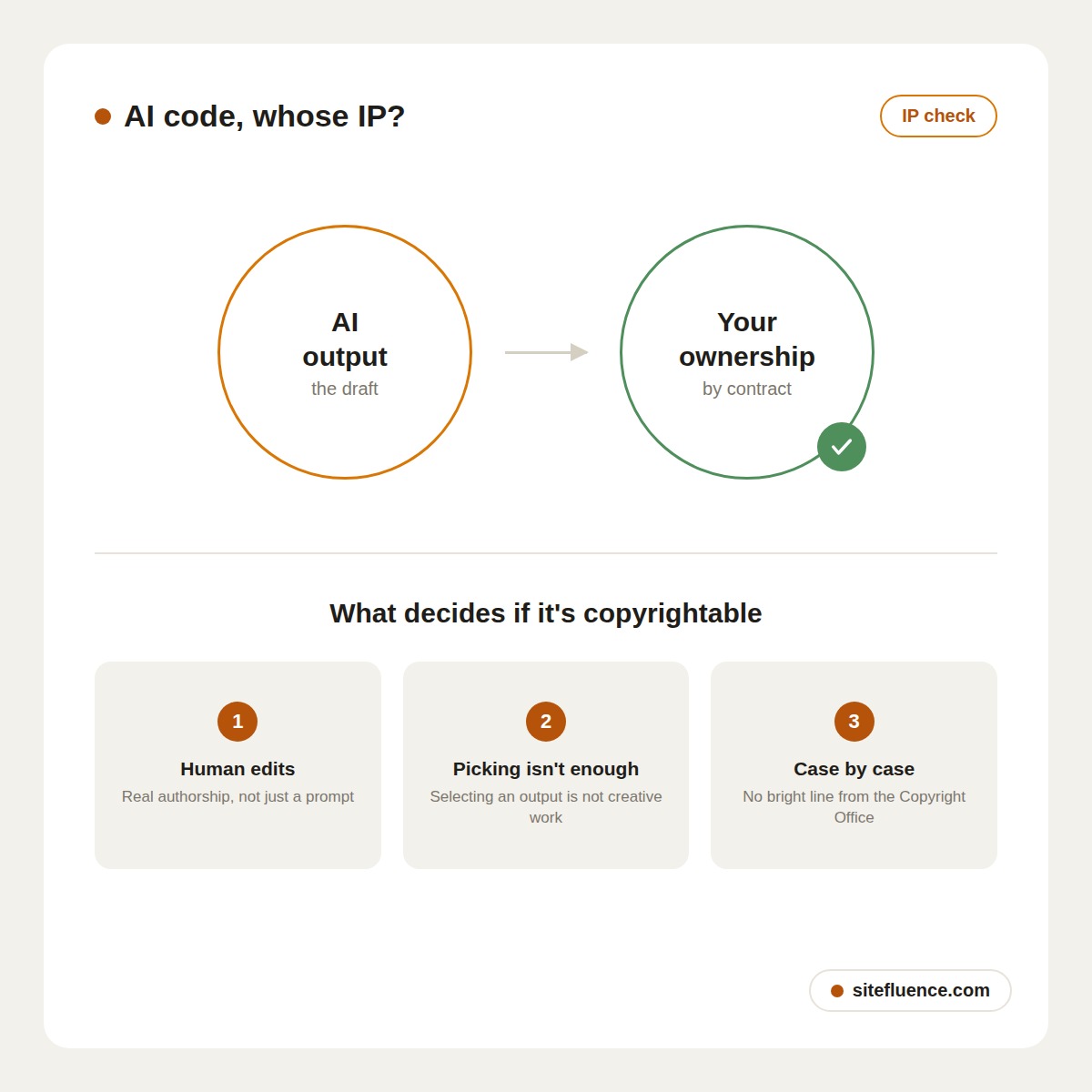
Yes, mostly. Anthropic's commercial terms say the customer "owns its Outputs," assigning Anthropic's own rights in that output to you.1 But owning a file differs from whether that file is copyrightable. The U.S. Copyright Office concluded in a January 2025 report that fully AI-generated output, produced from a prompt with no further human authorship, has no human author and isn't copyrightable.2 Owning it and stopping someone from copying it are not the same guarantee.
What the Copyright Office actually concluded
The Office's Part 2 report is specific: merely picking a single output from several AI-generated options "is not itself a creative act," so selection alone does not create copyrightable work.2 Where a human materially modifies, edits, or arranges AI-generated material in a creative way, the resulting work can be protected, but there is no bright-line rule for how much editing is enough. Every case gets assessed on its own facts, not against a fixed checklist.2
Deciding how to get it built? The free Vibe Code or Hire a Developer assessment scores your project in 8 questions and tells you whether to vibe code it, use a site builder, hire, or split the work.
Ownership and infringement protection are different things
Don't confuse this with Microsoft's Copilot Copyright Commitment, which indemnifies paying GitHub Copilot customers if a third party sues them over code Copilot generated.3 That protects you from being sued for copying someone else's work. It says nothing about whether your own AI-drafted code is copyrightable enough for you to sue a copycat. Founders often assume one covers the other. They don't.
Why this surfaces at fundraising or exit
This rarely bites a founder day to day, but it can turn up during fundraising or acquisition diligence, when a buyer's or investor's counsel checks what IP a startup actually holds. A product built entirely by prompting, with no meaningful human edits to the generated code, may have weaker copyright protection than a founder assumes, regardless of what the tool's terms of service say about ownership.
The fix is the same work a developer already does
The Copyright Office rewards exactly what a developer does after the first draft: refactoring, fixing bugs, making architectural calls, rewriting logic. That is meaningful human authorship, and it is what makes the result the founder's protectable work, not just handed-over AI output. Treat the first AI-generated version as a throwaway draft to prove the idea, then have a developer materially rework whatever matters to the business.
References
Footnotes
-
Anthropic. "Commercial Terms of Service" ↩
-
U.S. Copyright Office. "Copyright and Artificial Intelligence, Part 2: Copyrightability" ↩ ↩2 ↩3
-
Microsoft. "Microsoft announces new Copilot Copyright Commitment for customers" ↩