No, but it changes what investors ask
Using Bubble does not hurt your chances of raising. Cuure, a Paris supplements startup, built a working prototype on Bubble in one weekend, made its first sale within three months, and raised seed funding about six months after starting, without ever hiring a CTO. Co-founder Jules Marcilhacy still calls the company "Bubble first."1 The tool is not the blocker. Investors ask sharper questions instead, about scale, defensibility, and what happens after the term sheet.
Real venture money has gone into Bubble apps
Beyond Cuure, Bubble's own blog cites Comet, which reached $800K in revenue before raising a $13M round, Teal, which raised $5M for its careers platform, and Dividend Finance, which raised over $330M and processed over $1B in loans.2 Bubble itself is venture-backed too: a $100M Series A in 2021, part of $106.3M raised to date.3
Deciding how to get it built? The free Vibe Code or Hire a Developer assessment scores your project in 8 questions and tells you whether to vibe code it, use a site builder, hire, or split the work.
What investors actually probe for
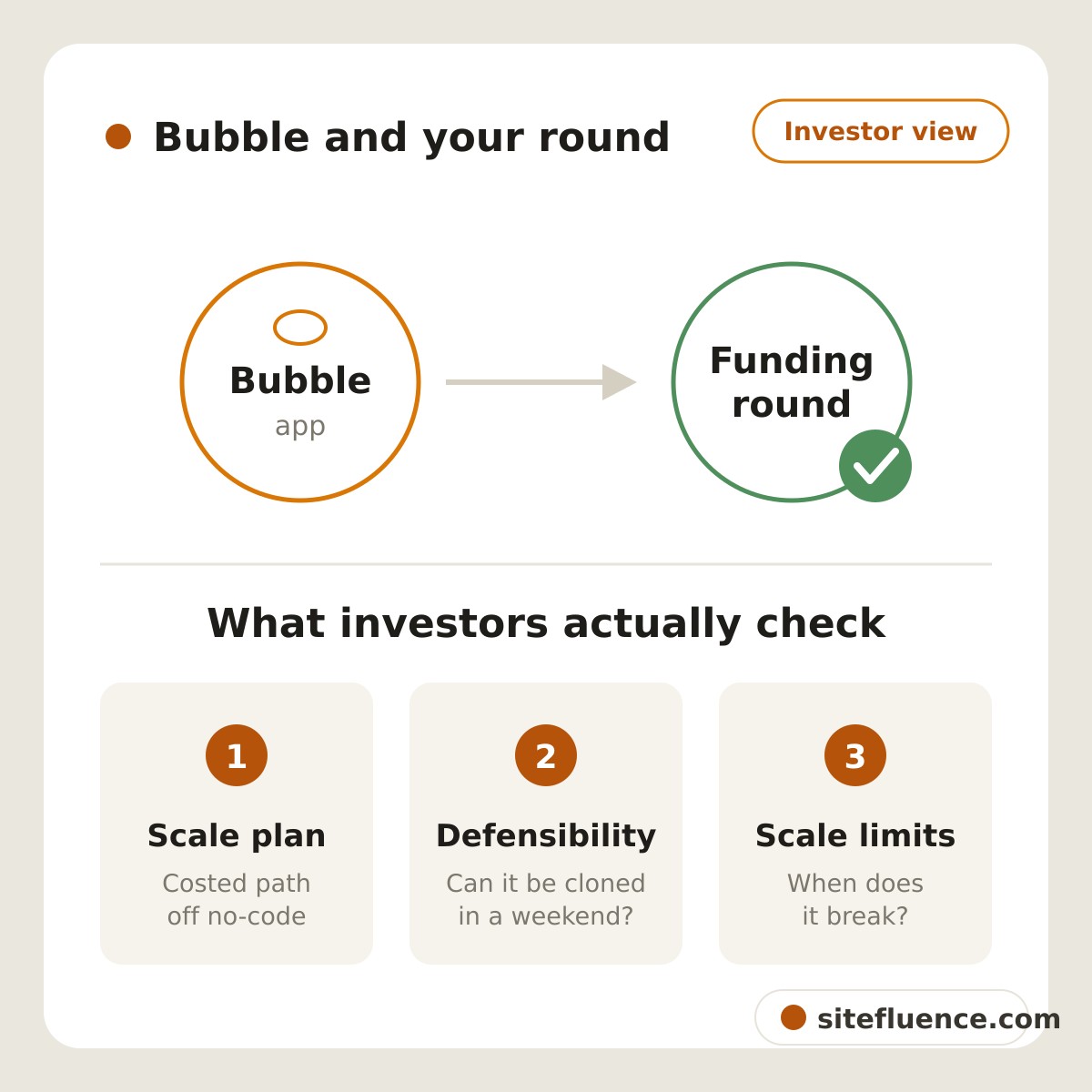
Nobody rejects a term sheet because a demo runs on Bubble. What they check is whether you have a costed, timelined plan for moving off no-code before you hit scale, whether the product is defensible once a competitor can clone the MVP in a weekend, and whether you have a straight answer for when the app breaks under real load.4 Come with answers, not a stack apology.
Bubble's own pivot, worth noting
In my view, the platform's sweet spot has shifted over time toward more complex, multi-role SaaS and marketplace builds, rather than the fast, single-purpose MVP it was known for early on. That does not change the funding question above, but it is worth knowing before you commit to the platform for a quick build.
The exit question, honestly
A 2023 Bubble forum thread asking for examples of Bubble companies getting acquired came up short. One founder reported a $7M seed round on a Bubble SaaS past a million in yearly revenue, but planned a custom-code rebuild anyway. Nobody named a clean, all-Bubble acquisition. One commenter argued acquirers care about financials and customer base, not where it is built, which is plausible but unproven.5 Treat this as open, not settled.
What actually gets you funded
In my experience, investors score technical judgment, not tool choice. The stack is just the cheapest signal on hand before real diligence starts. Strong traction with a credible migration story gets funded on Bubble. Weak traction gets picked apart on stack, because the stack is all that is left to critique. It is the same instinct behind proving an idea cheaply before funding the full build: traction settles the argument, not the tool.
References
Footnotes
-
Bubble Blog. "Why Wellness Company Cuure's Tech Stack is Bubble-First" ↩
-
Bubble Blog. "How to Explain Your No-Code Tech Stack to Investors" ↩
-
Clay. "How Much Did Bubble Raise? Funding & Key Investors" ↩
-
Built In. "How to Raise Money for a No-Code Startup" ↩
-
Bubble Forum. "Examples of Successful Exits/Acquisitions" ↩