Yes, and the permission engine is the difference
Verified September 2, 2026.
Originally published July 26, 2026.
OpenWorker is Andrew Ng's open-source desktop agent, MIT-licensed, announced July 23, 2026.1 The pitch is the same one OpenClaw made: an AI that touches your files, your terminal, and your work apps, and hands back finished work. The difference is that OpenWorker sorts every tool call into a risk class before it runs one. OpenClaw was the cautionary tale, with Bitsight counting over 30,000 exposed instances online in a two-week window.2
What it actually does
You ask for an outcome, not an answer, which is the same instruction shape that works on human teams. It splits the task into steps, works across your files and 25 plus connectors including GitHub, Slack, Jira, Notion, HubSpot, Gmail, and Google Calendar, then leaves a file you can open.3 React and Tauri on top, a Python agent server underneath, built on Ng's aisuite library.
Five risk classes, six modes
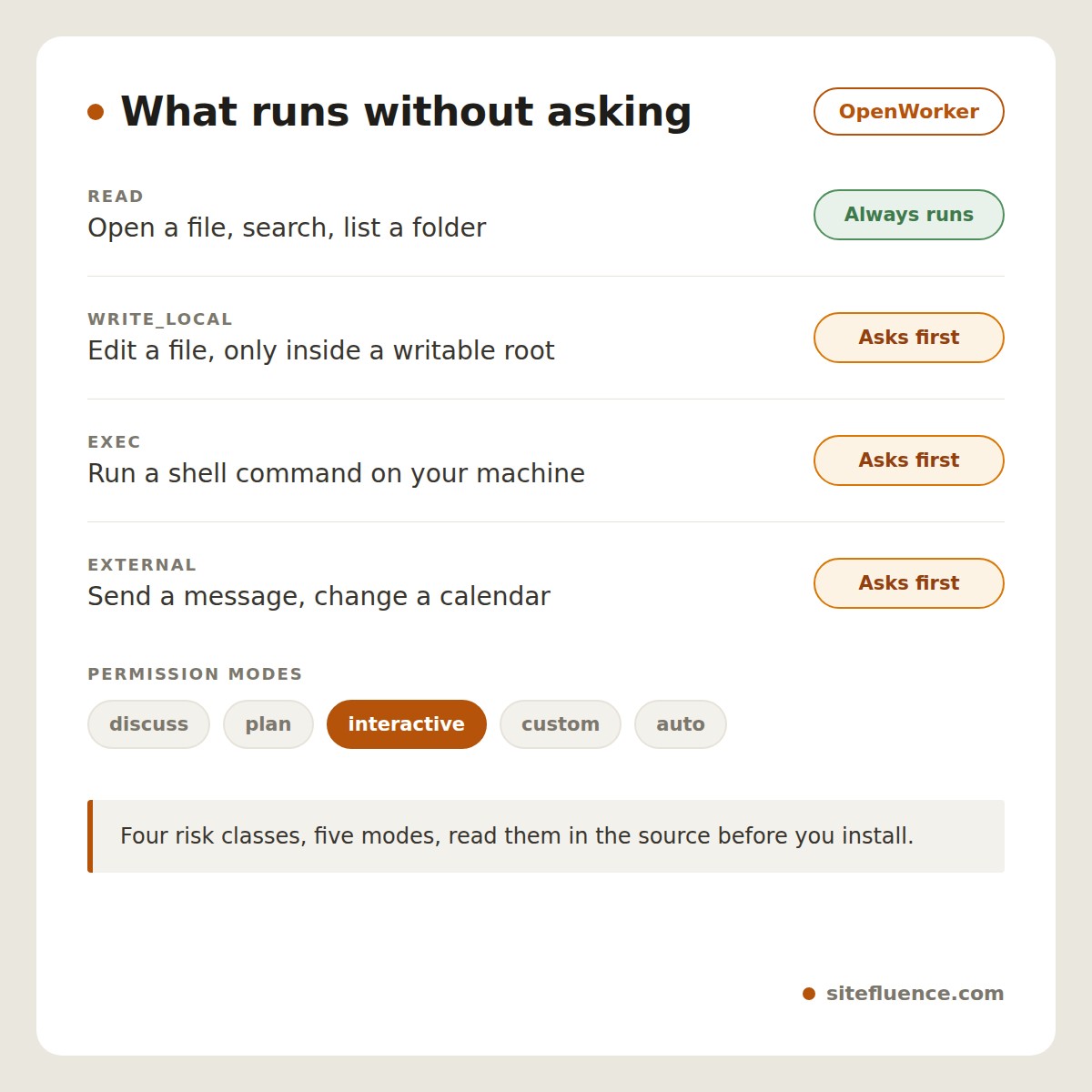
In the source, every tool is classified read, egress, write_local, exec, or external. Reads always run. Everything else meets a permission engine with six modes: discuss and plan are read-only, interactive asks before writes and commands, custom auto-approves a named list, auto-approve sends each approval card through an LLM reviewer first, and bypass-approvals, renamed from auto on August 12, allows everything except the hard floors. MCP servers default to requiring approval, and writes must resolve inside a folder you marked writable, so a relative path cannot climb out.
The allowlist detail that gives it away
You can allowlist shell commands to skip approval. The code rejects any command containing a backtick, $(, $, >, <, or (, splits the rest on ;, &&, and |, and matches each part's parsed arguments against the allowlist rather than raw text. The comment says why: git status && git diff runs when both are allowed, while git status && rm -rf ~ does not. Someone sat down and asked how their own convenience feature gets abused. That is not vibe coding.
It credits OpenClaw in its own source
Line three of coworker/secrets.py reads: "Design (from OpenClaw): secrets never enter the model's context, prompts, or traces." It is the only mention of OpenClaw in the repository. One idea taken, credited in a code comment nobody was supposed to read, and the rest of the security posture rebuilt from scratch. That is the honest version of what happened here.
Where it is still beta
The same file calls the store "a 0600 JSON file" with a Keychain backend planned later, so connector tokens sit in plaintext that anything running as your user can read. Windows builds are not code-signed. Bypass-approvals mode really is full access on shell, minus the hard floors; auto-approve routes shell through the reviewer and those same floors. Judge it the way you would any agent you hand a real machine to: read the modes, then pick one. Still choosing that agent? Start with Codex vs Claude Code vs GitHub Copilot, or the editor-side version, Windsurf vs Cursor vs Claude Code. Deciding whether to run one yourself at all, or hire the build out? Take the vibe code or hire check.
References
Footnotes
-
Andrew Ng. "Announcing OpenWorker!" ↩
-
Bitsight. "OpenClaw Security: Risks of Exposed AI Agents Explained" ↩
-
GitHub. andrewyng/openworker README ↩