Yes, but not natively
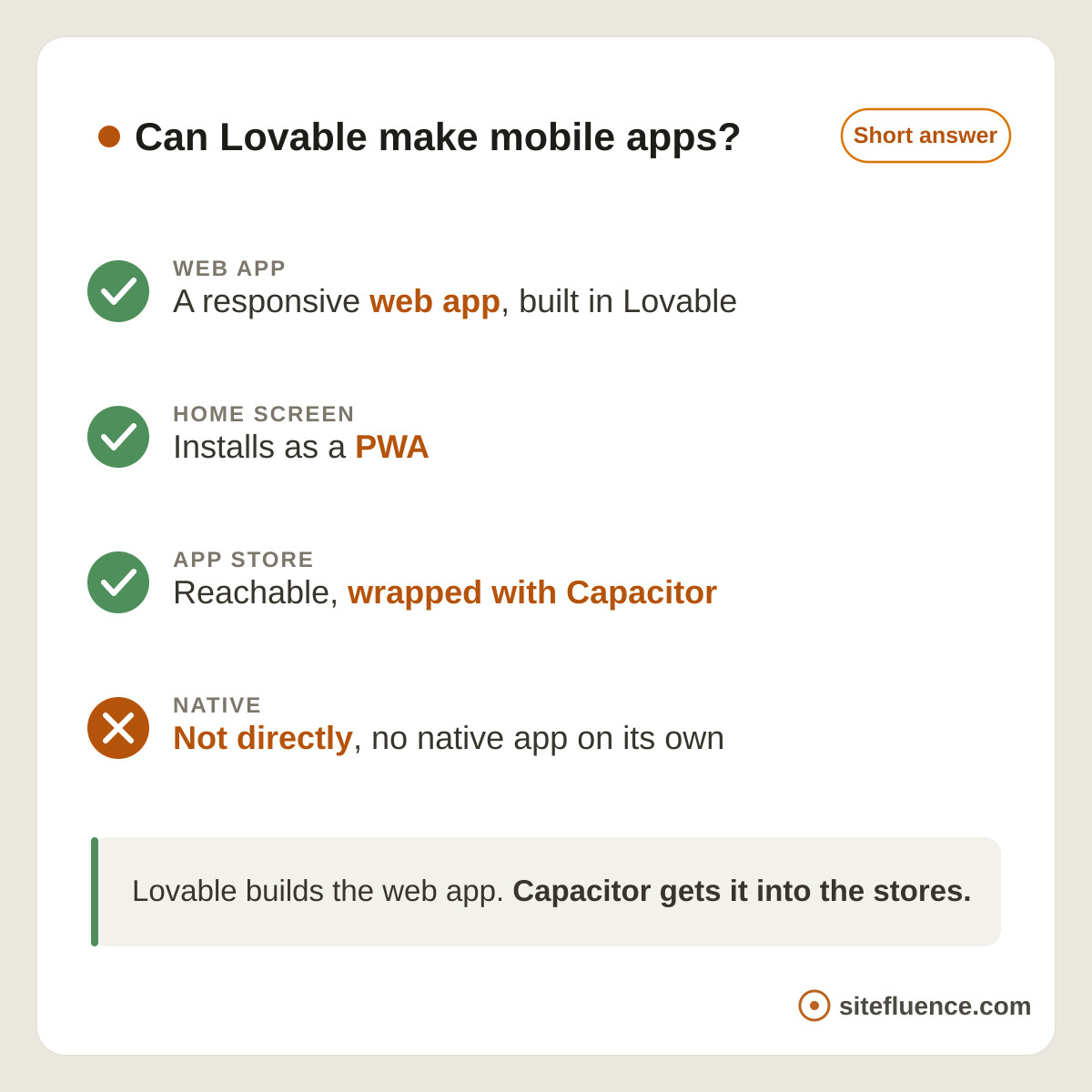
Lovable does not produce a native iOS or Android app. It builds a mobile-responsive web app. Its own documentation says Lovable "specializes in web applications rather than native mobile development."1 You reach phones two ways: install the web app to the home screen as a Progressive Web App, or wrap it with a tool like Capacitor to submit to the App Store or Play Store. So yes, with a wrapping step.
What Lovable actually produces
The artifact is a web app. Apps built after May 13, 2026 use TanStack Start with server-side rendering; older ones use React plus Vite, both styled with Tailwind.1 It runs in a browser and adapts to a phone screen. That responsive site is the thing Lovable hands you. Nothing native comes out of the tool itself, which is the part most founders miss.
Do not confuse it with "the Lovable mobile app"
In April 2026 Lovable shipped its own iOS and Android app.2 That app lets you build and edit Lovable projects from your phone. It does not turn your project into a native app. Two different things share the name "mobile," and that overlap is where a lot of the confusion in search results comes from.
Deciding how to get it built? The free Vibe Code or Hire a Developer assessment scores your project in 8 questions and tells you whether to vibe code it, use a builder, hire, or split the work.
Getting it into the App Store
Wrapping is real work, not a checkbox. Capacitor, from the Ionic team, or a service like Median wraps your web app in a native shell, and Median can add native features such as push notifications.3 For iOS you also need an Apple Developer account, a Mac running Xcode, and, since April 28, 2026, a build made with Xcode 26 or later.4 None of that is something Lovable does for you.
The rejection risk nobody mentions
Apple rejects apps that are just a website in a wrapper with no native function. Its minimum functionality guideline is explicit about it.5 A bare Capacitor shell of your Lovable app can get bounced at review. Add real native behavior like push notifications, or expect a rejection. This is the exact spot where a lot of founders get stuck after the build feels finished.
When to wrap and when to hire
Wrapping fits MVPs, internal tools, and content apps that mostly need a browser view pinned to a home screen. Need real native performance, heavy device access, or a guaranteed approval on a deadline, and the wrapper route turns fiddly. The honest move: prototype in Lovable, prove the idea, then decide whether to wrap it or hand it to a developer. The tool answers the question; it does not settle the plan.
References
Footnotes
-
Lovable Blog. "The Lovable mobile app is here" ↩
-
Median.co. "How to Convert Your Lovable Web App Into a Native App" ↩
-
Capawesome. "Apple's New Xcode 26 Requirement for Capacitor Apps" ↩
-
Apple. "App Store Review Guidelines" ↩